

A lost scientific discovery found in an attic.


Ship Treasure. It was thought that Captain Perkins’ data, film, papers, and artwork were lost to time. But when migratory bird biologist Anna Peterson interviewed his daughters for an article she was developing, a relationship formed that would lead to the rediscovery of Perk’s artifacts.
September 1962.
Perk opens the door to the thick scent of cold wet iron. As he squints against the deck lights, the freighter’s speed is revealed by minuscule rainbows reflecting in fog moving past the wheelhouse. Droplets form on his heavy peacoat, the officer jacket of the Pittsburgh Steamship Division. He pauses to sip coffee from the lip of a mug, lest he spill in his eagerness to witness what he’d predicted would happen this night.
“Captain Perk, watch your step!” the lookout yells. “Many are still alive.”
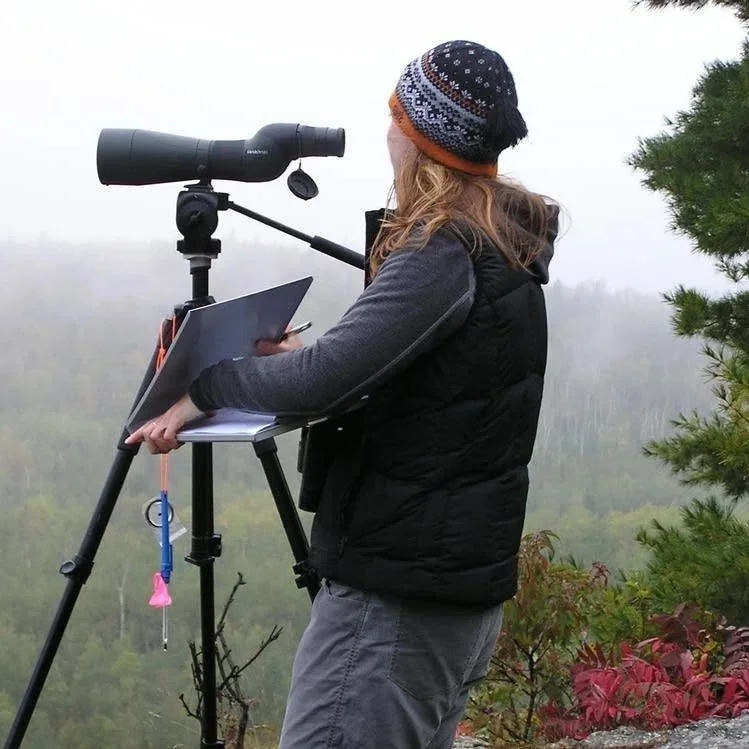
RECORDING MIGRATORY BIRDS. During both spring and fall, the coastal areas of the North American Great Lakes host massive migratory bird movements and provide essential stopover habitat for the travelers to rest and refuel. Image: Derek Montgomery / MPR.
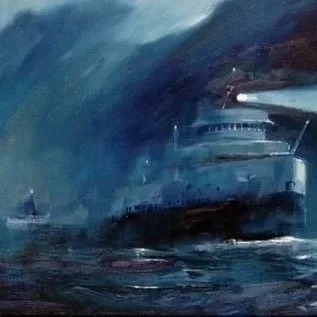
WEATHERING THE STORM. Migratory birds crossing the North American Great Lakes often seek refuge and rest aboard ships, especially during inclement weather. Painting: Neil Davison
September 2010.
I met Captain J. P. “Perk” Perkins in a photo near the center crease of an old magazine. A week had passed since I witnessed what my colleagues at first dubbed a product of a vivid imagination. At a high point along Lake Superior’s northern coast, a predawn cloudburst of songbirds suddenly appeared in the sky above and around me. Thousands of warblers, thrushes, grosbeaks, vireos, and other birds moved en masse from the direction of the lake. Shortly after the sun cleared Superior’s horizon, they vanished.
Sometime later, a frayed magazine landed on my desk with the note, “Read This,” marking a page. By then, the captain had been gone for 20 years.
- Anna Peterson, NatureWerks, excerpts from essays developed with funding from the Minnesota State Arts Board

An Ore Ship Captain and His Onboard Forest
From 1928 to 1972, Captain J. P. “Perk” Perkins sailed the Great Lakes onboard freighters that carried ore and other cargo between Lake Superior and Lake Erie. Perk had a unique passion for birds. For the majority of his life as a mariner, Perk recorded the migratory birds that sought shelter on his ships. He placed bird seed, fresh water, and a cobbled assortment of potted trees on his freighter's deck to attract and better film the birds, an assemblage the crew named Perk’s National Forest.
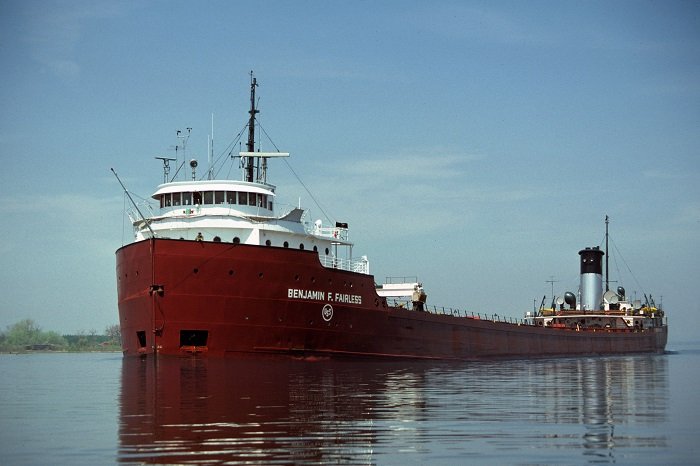
GREAT LAKES IRON ISLAND. From hawks to hummingbirds, Captain Perkins recorded over 150 species of migratory birds using his freighters as overwater refuges. The 622 foot Benjamin F. Fairless was one of several ships that hosted Perk’s National Forest. Image: Roger LeLievre / Shipwater News.
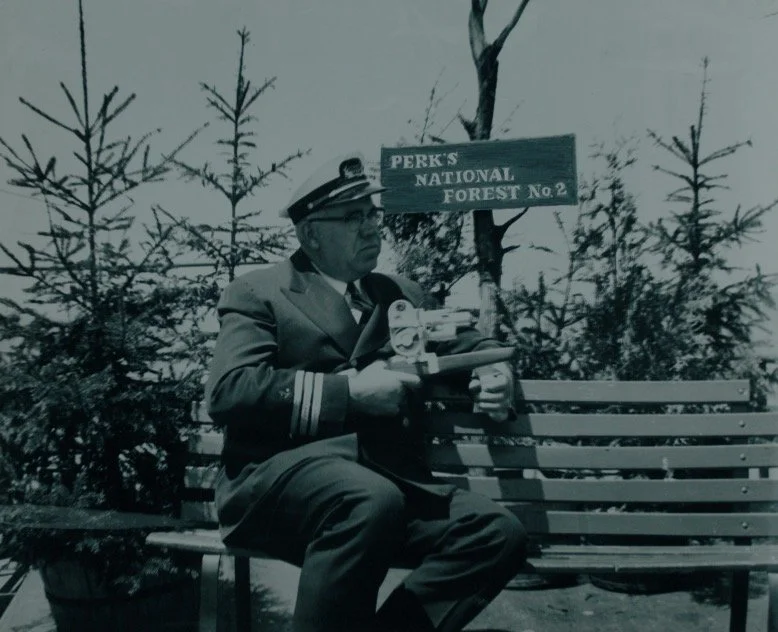
SHELTERING IN A FREIGHTER’S FOREST. In 1958, after years of photographing the migratory birds that landed on his ships to rest during migration, Captain J.P. Perkins (pictured) created a mini-forest of potted trees for the feathered castaways. Image: J.P. Perkins / U.S. Steel.
Mapping Migration Routes
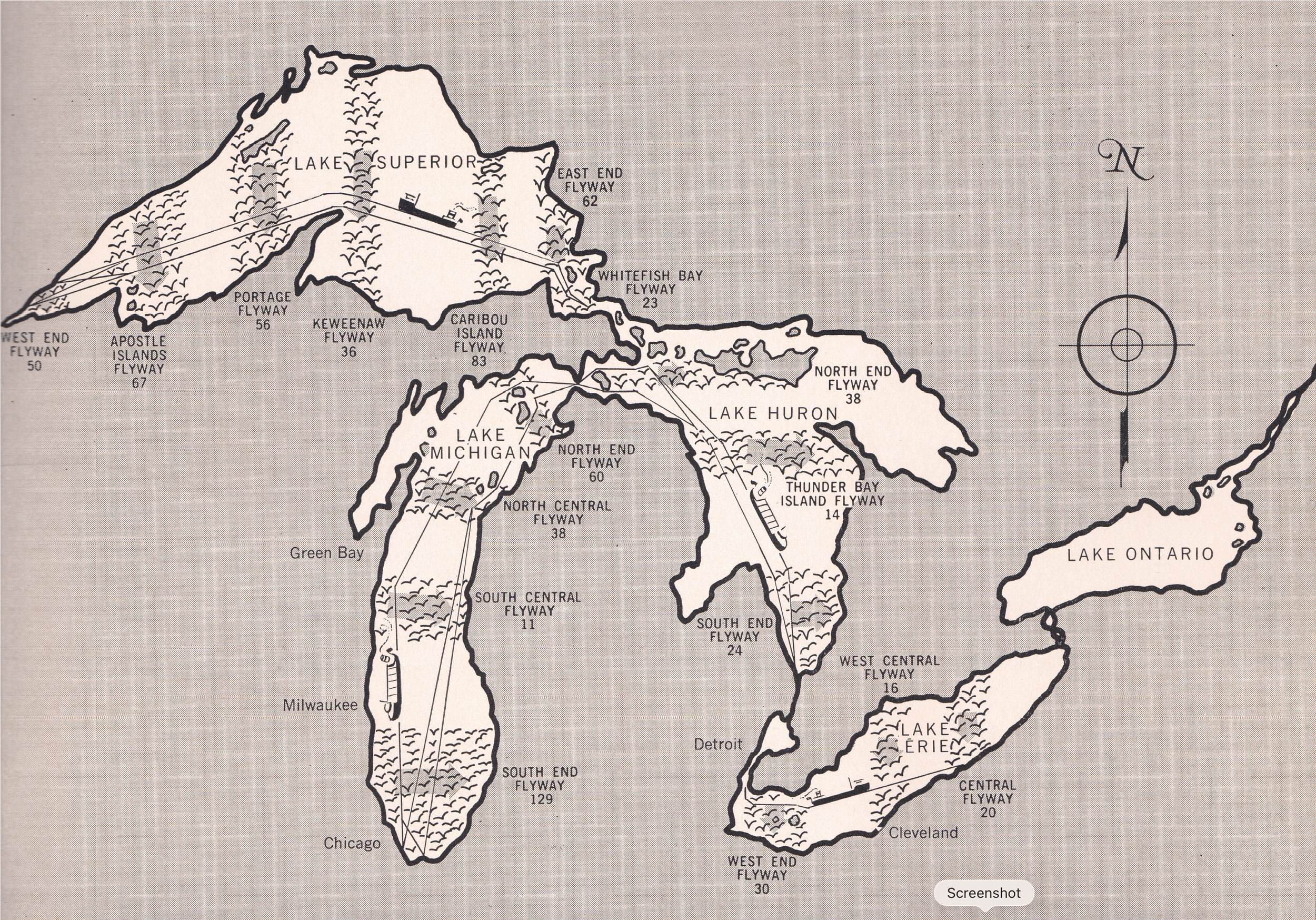
A CAPTAIN AND A SCIENTIST. Based on his observations and experience, Perk published this map of Great Lakes migratory flyways based on where his freighters would cross into heavily used flight paths. Image: J.P. Perkins / Audubon Magazine 1964
After decades of sailing the Great Lakes, Captain Perkins could predict when his freighter would enter any one of 17 different flight corridors that hosted massive numbers of migrating birds. He documented and told stories of his bird migration observations through a film productions he called Birds Ahoy and Wings Over the Inland Seas. He also published a hand-drawn corridor map in Audubon Magazine to educate the public and scientific community about these over water movement corridors. Such flyways have significant conservation implications and beg for replication and comparison using modern techniques. But Perks’ vantage point was so unique that compartive research will take a coordinated multi-year effort among partners using innovative methods.
A Migration Phenomenon Under Threat
Every fall 90% of the biodiversity in North America’s boreal forest takes to the sky in one of the world’s largest natural phenomena — the boreal bird migration. But in the past 50 years, North America has lost 2.9 billion birds, one-third of the avian population. Most of those lost are migratory birds. One-third of the 4 billion birds that migrate south in the fall will not survive to return in the spring. Human caused threats throughout this journey compound and accelerate already high levels of natural mortality.
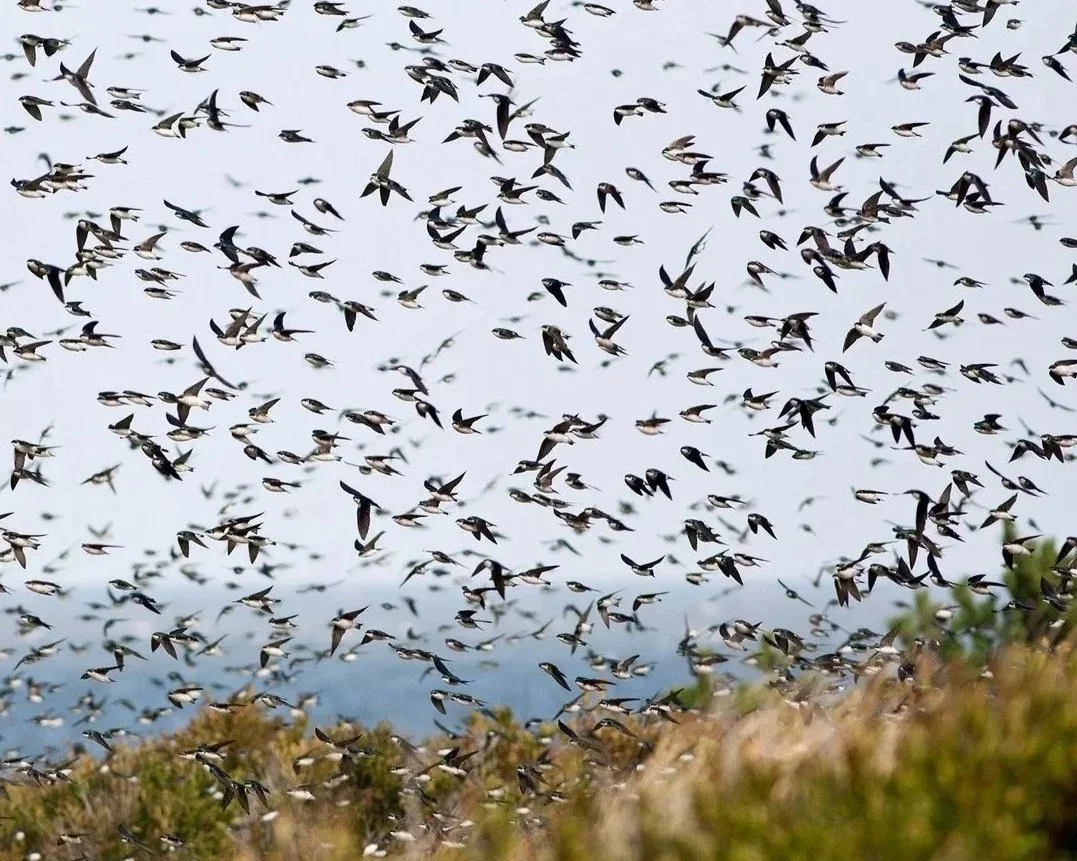
AN ANCIENT RHYTHM. Migratory birds tend to concentrate in large numbers along any number of U.S. coastlines, including the N. American Great Lakes. Aerial insectivores such as these migrating tree swallows face the steepest declines of any avian guild. Threats include habitat loss, pesticide use, and the impacts of climate change on timing and emergence of migratory food sources. Image: William Leaman / Alamy
During spring and fall migrations, billions of birds travel on a movement trajectory that guides them towards the North American Great Lakes region. Ten percent of the U.S. population (over thirty million people) and thirty percent of the Canadian population (eleven million people) live within the watersheds of the Great Lakes. This includes the cities and metropolitan areas of Duluth, Green Bay, Milwaukee, Chicago, Detroit, Windsor, Toledo, Cleveland, Buffalo, and Toronto. These same coastal areas host disproportionally large concentrations of birds during migration. Impacts from the most dangerous human-centric threats to birds — including habitat loss, predators, pesticides, and collisions with manmade structures such as buildings, communication towers, wind turbines, and power lines — are intensified in these populated coastal regions.
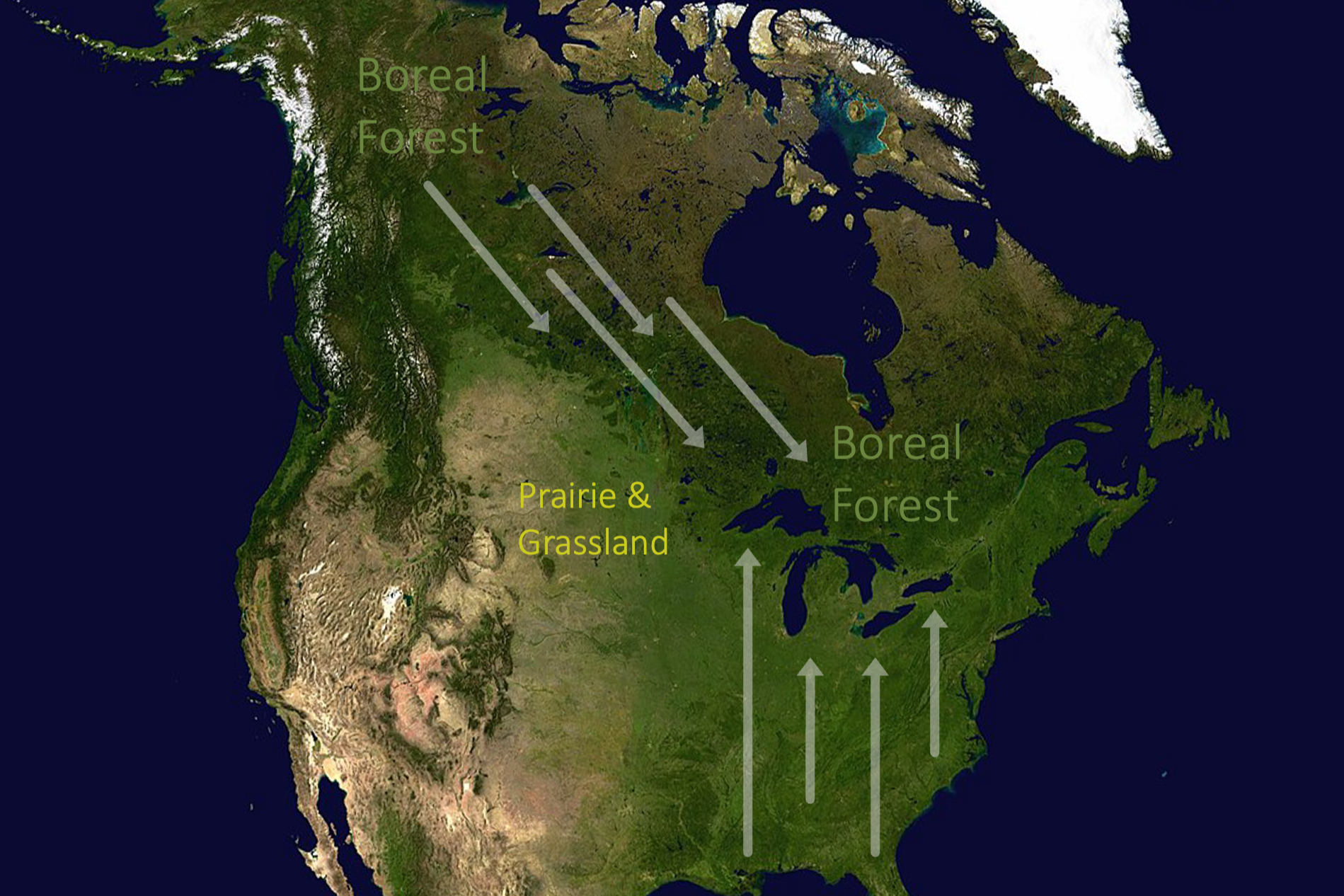
A CONTINENTAL PHENOMENON. Every fall, up to five billion birds migrate out of North America’s boreal forests to areas as far south as South America. Avoiding the prairies and guided by NW winds, many migrate to and through the Great Lakes region. With only two-thirds surviving the round trip journey, each spring two- to three-billion birds return through the forests of eastern US to their natal breeding grounds. Once again, the Great Lakes are a formidable barrier and essential stopover. Image: NatureWerks
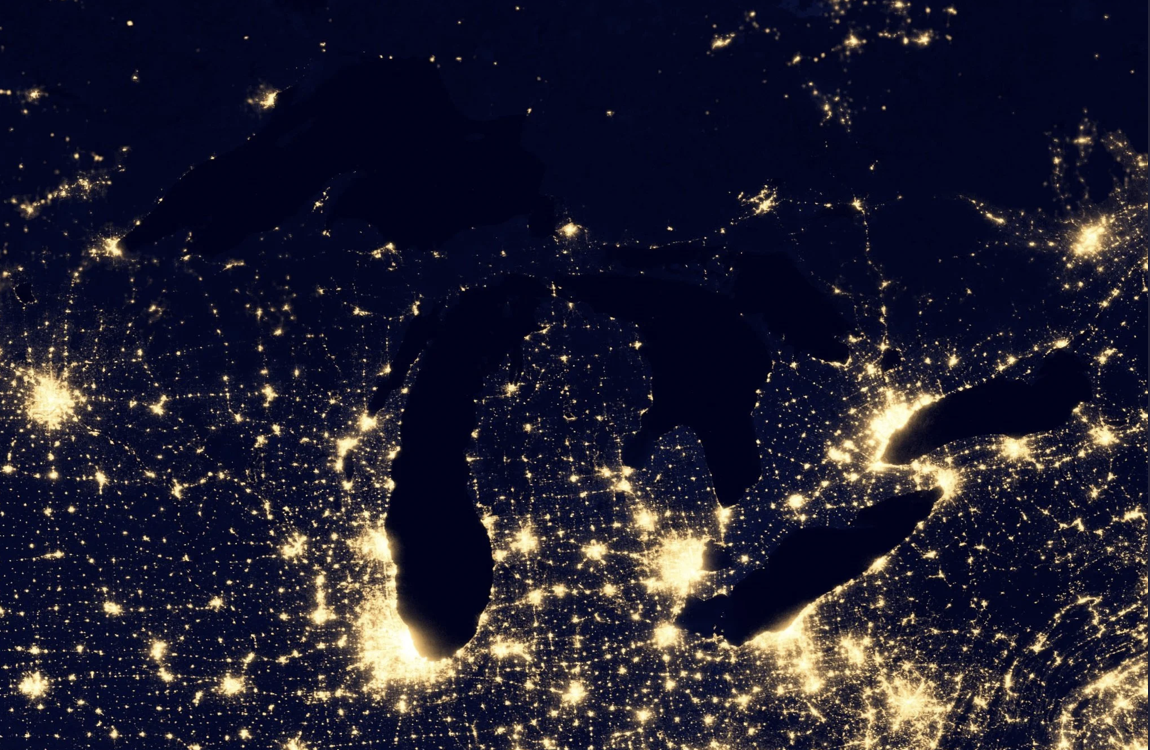
ATTRACTED TO COASTAL GLOW. Nocturnally migrating birds are drawn to artificial light and disproportionately concentrate their movements and stops within Great Lakes coastal cities. Within these ‘light halos,’ mortality caused by collisions with structures and predation by house cats is intensified. Image: National Geographic
Simple Bird Friendly Solutions Exist, but Are Slow to Take Hold
On a single night in October 2023, nearly 1000 migrating birds died near the shoreline of Lake Michigan when they collided with the windows of Chicago’s McCormick Place convention center. For decades it had been known that this building’s huge lakeside wall of glass caused bird collisions during migration but calls for action went unheard. Then, following this mass tragedy, bird advocacy groups and building owners worked together to have the McCormick Place glass retrofitted with a treatment to make it visible to birds. That action reduced collision mortality by 95% the following fall.
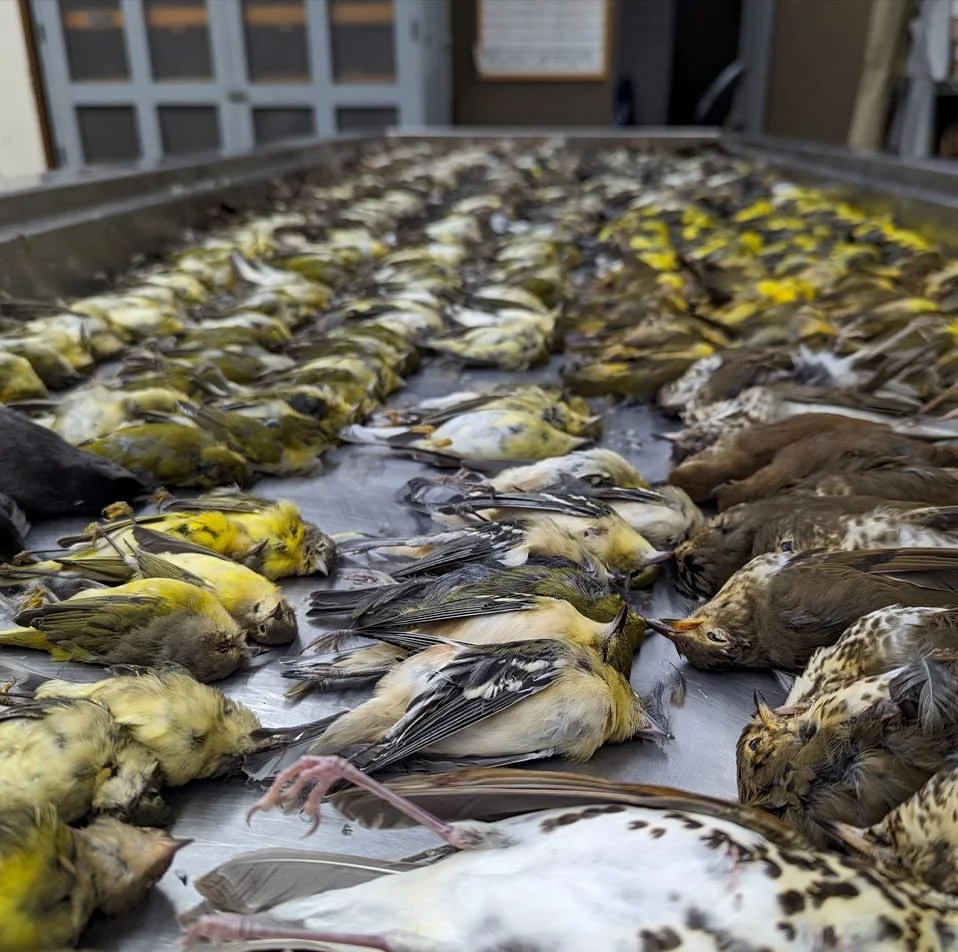
ONE NIGHT, ONE BUILDING, 1000 DEAD. The avian victims of a Chicago window strike mass casualty event in October of 2023. Photo: Daryl Coldren / Field Museum of Natural History.
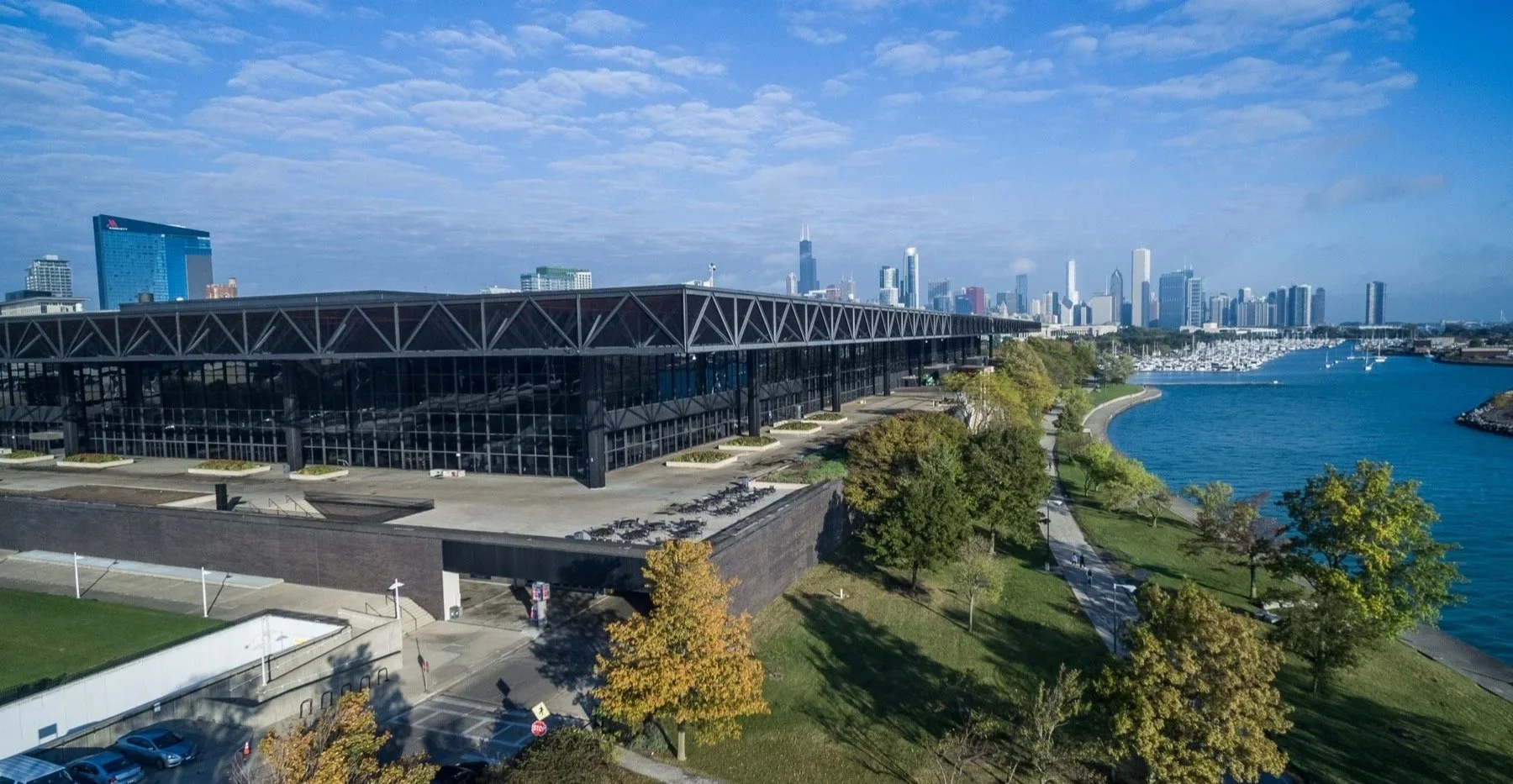
URBAN TRAPS & OPPORTUNITIES. Bird friendly glass reduced window strikes on Chicago’s McCormick Place by 95%, but it took a tragedy and collective action to motivate change. Photo: choosechicago.com
Science and technologies to promote safe passage for migrating birds are proven, as are models of communities working together to take collective action. But widespread awareness of the Great Lakes migration phenomenon itself is still in its infancy and simple conservation actions are largely unrecognized and too seldom implemented.
Adoption of new socially or environmentally beneficial practices is shaped more through compelling stories and values shared through social networks than by scientific or economic information alone. This project inspires conservation through motivating stories, targeted multi-media, and grassroots campaigns designed to build community pride in the Great Lakes bird migration and motivate collective action to protect it. For more information on what you and your community can do to help birds, join our mailing list and check out the resources and examples assembled by Bird City Network.